By John Beydler
Copyright 2020, All rights reserved
Daniel G. Stratton, Jerico Springs’ founder, “is a man of nerve and action,” the Lamar Democrat said in an 1889 story about one of his ventures.
The assessment seems accurate, given his life. Born Feb. 18, 1828, in Adario, in north central Ohio, he was living in western Illinois by 1850. Mr. Stratton spent nearly 20 years as a merchant in Cambridge before moving to Missouri and founding Jerico, after which he eventually made his way to Colorado, where just months before his death in December 1900 he described himself as a gold prospector.
Mr. Stratton apparently enjoyed a degree of financial success in Cambridge.
The 1870 Census, taken when he was 42, described him as a “retired man” who had $8,000 worth of real estate and $800 worth of personal property (a total of $174,000 in 2020 dollars). Land records indicate he was still in Cambridge in 1875. Between then and 1880, he moved with his wife, Emily, and two daughters to Stockton, where that year’s Census lists them as residents.
He was soon on his way to becoming “a large property holder in and about Stockton,” as the Cedar County Republican described him later.
Sometime shortly after his arrival someone told Mr. Stratton, who suffered some chronic health issue, about Carrico Springs about 15 miles west of Stockton and their reputed medicinal properties.
Owned by J. B. Carrico, who homesteaded it in 1857, the spring site had long been visited by health-seekers, including early settlers and before them, Native Americans.
According to Goodspeed Publishing Co.’s History of Hickory, Polk, Cedar, Dade, and Barton Counties, Missouri, Mr. Stratton, “Skeptical at first, finally tried them, and was delighted when a complete cure was effected. Having satisfied himself, by watching the experience of other invalids, that the springs unquestionably possessed great medicinal properties, Mr. Stratton bought the tract of ground containing them,” the Goodspeed history said.
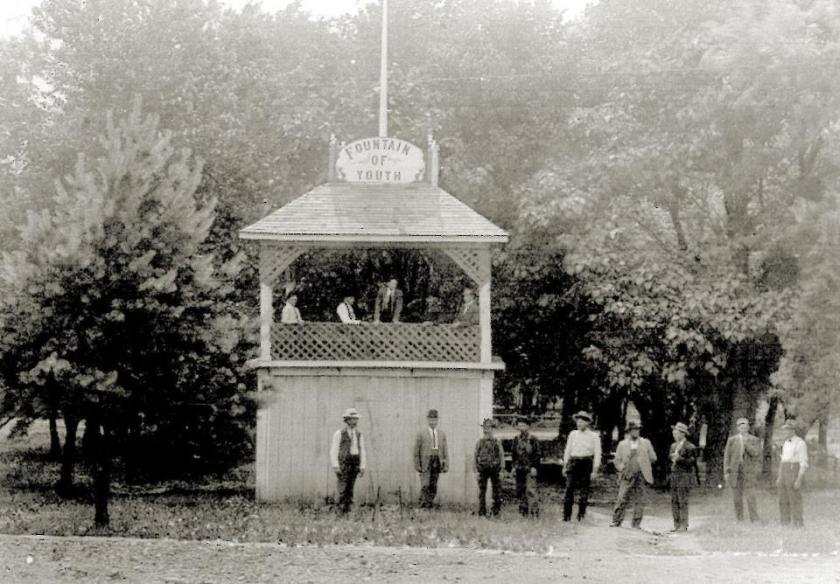
Envisioning a health resort, Mr. Stratton platted the original town of Jerico Springs sometime in 1881-82. Assisted in the work by C. E. Whitsitt, a near-by farmer who would play a major role in the new town, Mr. Stratton also cleaned up the area around the springs and planted trees in the future park.
Mr. Whitsitt’s home was moved to the town site from his farm just to the west and the date its reconstruction began, June 9, 1882, was marked for more than 130 years by the annual Founders Day Picnic, widely known as the Jerico Picnic.
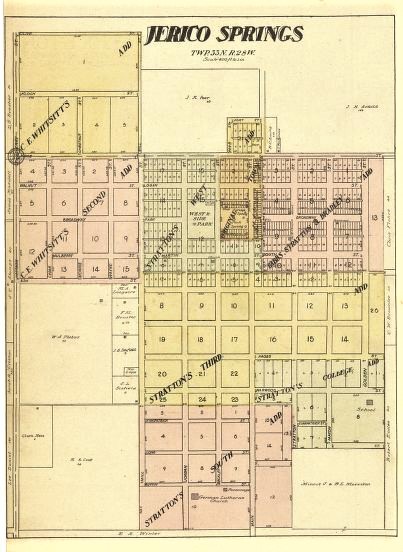
The new town grew rapidly. By the time Jerico incorporated March 5, 1883, several additions were on the drawing boards, including Stratton & Bradley’s east addition, Stratton’s west addition, Stratton’s south addition and Stratton’s fourth addition.
How the town came to be Jerico Springs rather than Carrico Springs is a mystery. One theory is that some county or state official mis-heard or mis-read “Carrico” as “Jerico” when filling out paperwork and the name stuck. Another theory, widely accepted, is that “Carrico” was combined with the Biblical “Jericho” to get the name.
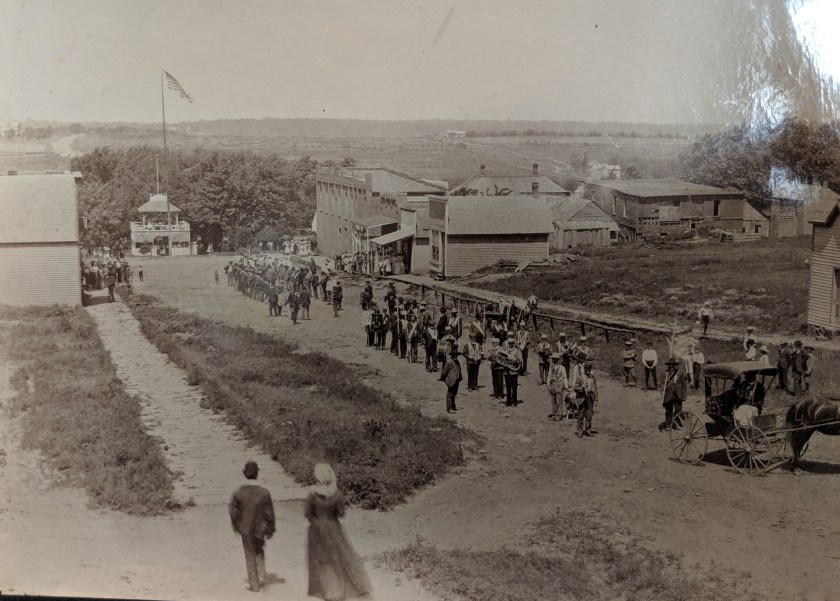
When the 1890 Census came around, Mr. Stratton’s seven-year-old town had zoomed to a population of 486 people, driven in good part by Mr. Stratton’s promotional efforts.
The Stockton papers described him at various times during the 1880s as “the live projector of our neighbor city Jerico,” “an enterprising real estate dealer of Jerico,” “the founder of the Mystic City (who) has always carefully guarded its interest and contributed to its up building,” and “a progressive citizen and never fails to donate something to all public enterprises.”
The latter description came after Mr. Stratton vowed to “give 40 acres of land near Stockton towards raising the bonus for the Greenfield and Northern railroad.” Stockton, though, had no better fortune than Jerico in attracting a railroad.
He also gave away lots in Jerico, sometimes to draw people to town, other times as a reward: In 1888, he gave Jerico Springs Optic editor Theodore Kerr a lot valued at $500 in recognition of his efforts promoting Jerico.
At some point in the mid-80s Mr. Stratton moved his family to Cimarron, Kan., where he had a brother and where his daughter, Josie, 23, died Oct. 17, 1885. By July 1886, he had moved back to Jerico.
On Jan. 5, 1888, the “Jerico jottings” section of the Stockton Journal reported “Our worthy towns-people Mr. and Mrs. D. G. Stratton on Christmas day gave a splendid reception and dinner to a number of their friends at the Barker hotel in this city.”
Over the next 10 years of so, he continued his real estate business and invested in various other ventures, including a prospective lead mine near Golden City.
By the latter part of the 1890s, his health was deteriorating. On Feb. 17, 1898, the Jerico Optic said, ” D.G. Stratton is quite ill at his home in Jerusalem. His mind has again become affected and his condition makes it possible that his days of usefulness are over. He has the sympathy of the entire community.”
He and Emma moved to Colorado Springs, Col., where they lived with their daughter, Minnie Morrison. Emma died Aug. 26 , 1900. He died four months later, Dec. 20, 1900. The local paper, in a one paragraph obituary, said he died “after a long illness. The deceased had been suffering from brain trouble for some time.”
Though his long-time associate in Jerico, C. E. Whitsitt, had been trying to sell Mr. Stratton’s Cedar County holdings since 1898, there was apparently considerable remaining when he died without a will. Estate proceedings dragged on until at least the early 1920s.

