By John Beydler
I was born in Jerico in 1946, reared on a farm five miles west of town, attended Jerico grade school before going on to high school in Stockton; and I spent many hours listening to my Father and others of his generation talk about the town as it was in earlier, better times.
But my first hint that Jerico ever had a newspaper came when Kim Jefferies posted a picture of the Jerico Springs Optic on this page April 29. When someone mentioned here that there are microfilm copies of 36 years’ worth of the Optic in the Nevada Public Library, curiosity immediately grabbed the old newspaper man in me. (I put in 52 years as a reporter and editor at various dailies.)
I did some time exploring Jerico on the web and, during November, spent nine days poring over the microfilm in Nevada.
The first issue of the Optic was published March 30, 1888, by T. L. Kerr, according to a “History of Hickory, Cedar, Polk, Dade, and Barton Counties, Missouri” printed in 1889. It was the second newspaper in town, according to that history, which said, “the Jerico News was established in 1882 by A.M. Crockett from Nevada. It changed hands several times and suspended in 1887. It was independent in politics. The Jerico Springs Optic, a newsy Democratic sheet was established in March 1888 by Theodore Kerr.”
At some point the paper passed into the hands of A. M. Heifner, who is listed on the masthead as publisher when the microfilm record begins with the July 26, 1901 issue. One or another member of the Heifner family owned the paper until Mrs. Mary Heifner ceased publication with the Feb. 19, 1937 issue.
Most weeks, the Optic was a broadsheet four-page paper, laid out in a seven-column format and published each Friday. Photographs were rare; line drawings of people and as how-to illustrations were in most issues. Until 1930 or thereabouts, the front page was given over to international, national and state news. Page 4 was canned features about farm life, religion, health and household issues.
Pages 2 and 3 contained local news and advertisements. Those pages reflect a community that at the turn of the century was thriving, both economically and socially; one proud of itself and its assets; with many residents, the Optic editor among them, ambitious to grow their town of 443 souls (1900 U. S. Census).
I’m guessing that the Optic, bolstered by its job-printing shop, was at the least moderately prosperous. A subscription cost $1 per year (a 1901 dollar is worth $29.65 now, according to a web inflation calculator); advertising rates ranged from a nickel for a line of body type in one paper, to $65 per year for an entire column every week. From 1901-1910 at least 50 per cent, and often more, of each week’s issue was advertising.
Jerico’s business people were solid supporters of the Optic. Among those running large ads each week were the Little Acorn Store (owned by J. B. Carrico and featuring women and men’s clothing), Bartram Brothers (clothing), J. K. Peer (farm equipment, hardware and harness), Arthur Soash (blacksmithing and repairs), Sheppard and Jones (dry goods, groceries, shoes and notions), Arnold Brothers (dry goods, groceries and gents clothing), Jerico Mills (flour), and whatever bank or banks were in business at the time.
There was a section each week called “Professional and Business Cards.” In 1901-02, these typically included J.W. Jones, real estate agent; Tonsorial Artists, a barber shop operated by A. J. Herman; J. M. Bruster, attorney; C. C. Brownlee, physician and surgeon; H. K. Hocker, photographer; and E. R. Hightower, lawyer and real estate agent.
A second major source of revenue for the Optic was the patent medicine industry. Every issue included 6-10 ads for concoctions proclaiming a cure for whatever ailed a reader, be it “women problems” or kidney, liver, arthritis, back or heart issues. In addition, there would be at least one story, and often more, about someone somewhere whose ailments were overwhelming them until they tried whatever medicine being pushed. I’m assuming these stories were also paid for by the medicine companies, though that was not explicitly stated. (Such stories are called advertorials these days and the papers where I worked made very clear that they were paid-for advertising.)
Editorially, the front page contained the big story of the moment, be it the assassination of President McKinley or a “tropical” heat wave hitting the Midwest. The two right columns were usually given over to a sermon by Louis Klosch, who often cited the teachings of Thomas Talmage. Both were nationally known as preachers and educators.
Page 1 always included a sizable collection of Missouri briefs from the many papers with which the Optic had exchange agreements. The Optic’s editor favored those about politics and crime.
The bulk of the local news was one-paragraph items about who visited who, who was in town on business, who had just bought a new horse, etc. There were very few crime stories, which probably accurately reflects reality. In those rare instances when a crime occurred the Optic reported in depth.
The Optic closely covered the doings of the school, the churches and fraternal clubs, the latter of which included the The International Order of Odd Fellows, Rebekah Lodge, Woodmen of the World, Jerusalem Lodge and Modern Woodmen of America. Most all regularly sponsored events for the general community.
The junior and senior classes at Jerico High School put on their plays in the I.O.0.F. building, the auditorium of which was frequently used for various meetings and entertainments.
The Optic was a faithful follower of both the girls and boys high school basketball teams. In the summer, the paper chronicled the Jerico baseball team’s wanderings through Milford, Arcola, Caplinger Mills and other nearby towns.
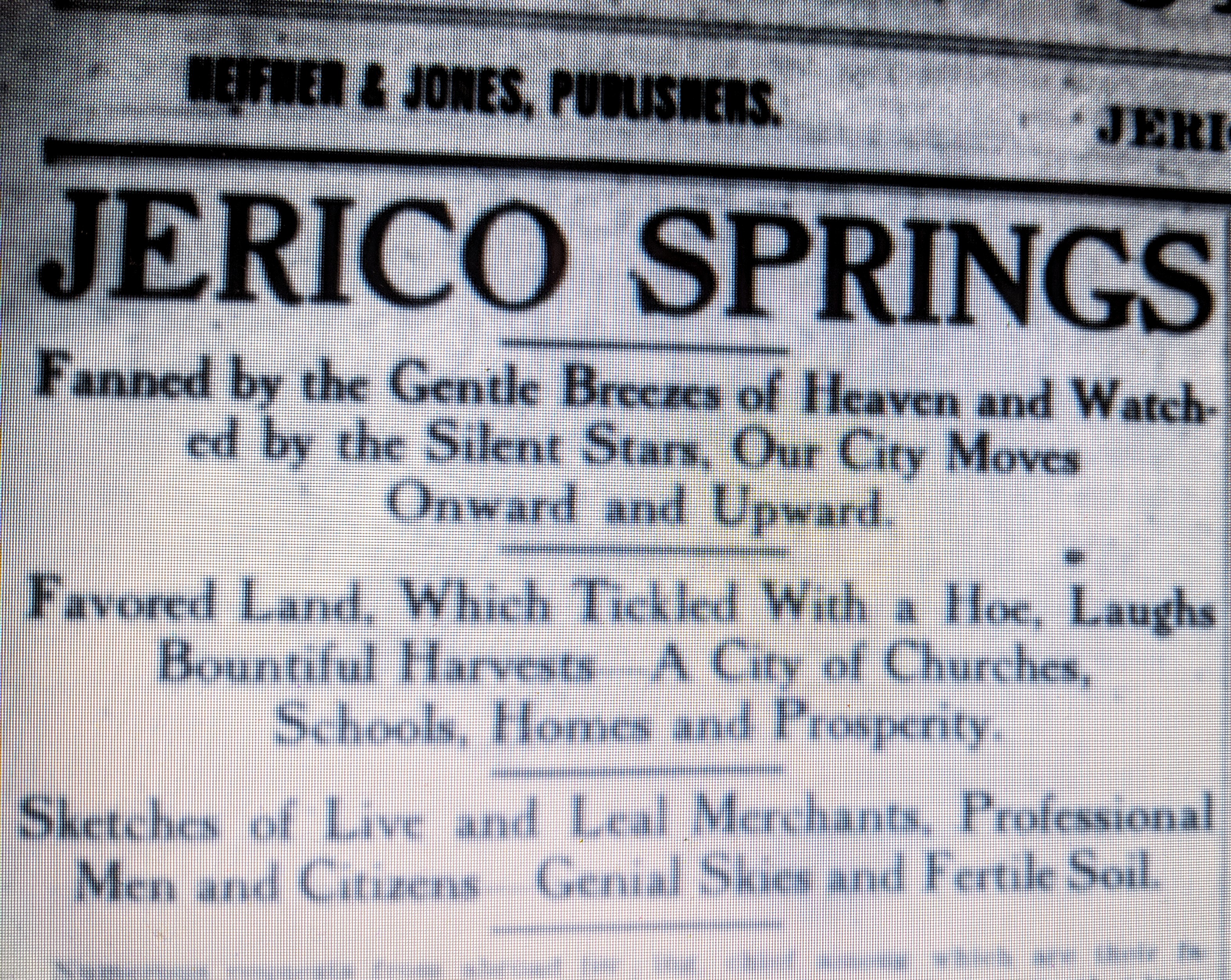
The Heifners were inveterate promoters of the town, frequently running stories extolling its virtues– the healing springs, good soil, its position as a trade center, etc.
A high point came Dec. 17, 1909, when a special issue devoted to Jerico’s businessmen and leaders was published. It includes a dozen pictures of people, stores and homes. The editor noted an extra $100 in production costs were incurred. He urged readers to share it far and wide.
The Optic’s editor also promoted the paper, running stories about the advantage of advertising. In one piece, he urged people to patronize local merchants rather than mail order houses, which “pay no taxes, support no churches or schools, and buy no goods in the communities whence they get their revenue.” (Substitute “internet” for “mail order house” and that discussion is still going on.)
I have not yet taken a close look at most issues between 1915 and 1930, but those I have looked at indicate there were few changes in the operation of the Optic. One was that, as more residents acquired radios and gained regular access to daily papers, the Optic increasingly devoted the front page to local news.
As the depression hit and wore on, Jerico increasingly paid the toll. The last bank closed in March 1929; other businesses disappeared as well. Those that remained were buying fewer ads, if any.
The shrinkage of the Optic’s local advertising base was devastating. Even the faithful patent medicine companies were buying fewer ads.
In 1936, a series of management changes were made but couldn’t halt the slide.
Late in the year, R.D. Heifner disappeared from the masthead. He was replaced by Mrs. Mary Heifner.
On Dec. 17, this announcement appeared: “Mrs. Mary Heifner has leased the Optic to Mrs. Bessie Kirkpatrick of Richland. Mo., late of Overland Park Kansas, who assumed active management Friday.
“Mrs. Kirkpatrick is an experienced newspaper woman and will endeavor to give the readers all the news of the community as well as important National and state items. She will be assisted by her daughter, Miss Elizabeth. The subscriptions, news items, job work etc., will be appreciated very much.”
On Jan. 22, Mrs. Kirkpatrick appealed for subscriptions. She said advertising revenue had fallen by two-thirds industry wide and noted that the Optic, unlike many papers, had not compensated by raising its subscription price or cutting the number of pages. “Newspapers are vital to the welfare of the communities they serve,” she said in a plea that every resident subscribe.
The same issue included this: “We will trade subscriptions to the Optic for wood, chickens etc.”
On Feb. 5, 1937, Mrs. Kirkpatrick announced she was giving up “It is with deepest regret that we publish our last issue of the Optic this week,” she wrote. “In the short time that we have been among you we have made many friends and become very much interested in your town, and it is only putting it mildly when we say it is with regret that we leave.
“We fully expected to spend many years with you when we came but circumstances over which we have no control and made it impossible for us to stay.”
After Mrs. Kirkpatrick departed, Mrs. Heifner resumed the editorship but gave up after putting out two more papers, on Feb. 12 and Feb. 19.
The final paper carried no announcement that the Optic was at an end. The only hint was a small ”for sale” ad on an inside page: “Anyone wanting to buy a good printing office cheap, write or call at the Optic office for particulars.”
— Mrs. Mary Heifner
Copyright 2019 John Beydler

